Friday, August 30, 2013

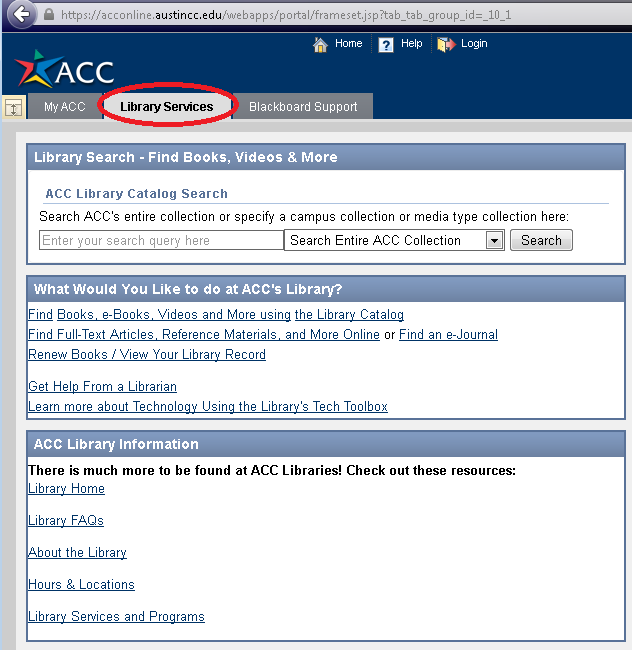
Did you know that the Library has a tab in Blackboard?

You can access the library’s resources quickly and easily. You can:
  • Search for books or videos
  • Connect to the article databases
  • Find help for your assignments
All in one place!

Just click the “Library Services” tab near the top of your Blackboard page.

Sunday, August 11, 2013

ARTstor - 1.6 million digital images for your free use


What is ARTstor?
     Over 1.6 million images in arts, humanities, social sciences and sciences.  

     Images cover prehistory to the present.

     Students - Create image folders for presentations/papers.

     Faculty - create folders for class use or assign for viewing outside class.

     ACC Staff - use images in your work and presentations


Why use ARTstor?

     Use images to challenge, inform, kindle the imagination and stir discussion. 

     It can be used remotely.

    
Best of all:  You do not need to secure rights to use these images; ACC’s Library subscription takes care of that!
(Exception:  personal use outside of ACC not covered.)


Subject areas:  
  • art, 
  • architecture, 
  • photography,
  • music, 
  • religion, 
  • anthropology, 
  • literature, 
  • world history, 
  • American Studies, 
  • Asian Studies, 
  • Classical Studies, 
  • Medieval Studies, 
  • Renaissance Studies, 
  • and much more.


Where do the images come from?
outstanding national and international museums,
photographers,
libraries,
scholars,
photo archives, and
artists and artists' estates.


Who can use it?
Currently enrolled ACC students -After you enter ARTstor, look in upper right to register.

ACC faculty  - Very important for faculty and staff
Email the Library E-Resources Librarian, Adrian Whatley(adrian.whatley@austincc.edu) in order to set up instructor privileges.

What are these privileges?   
  • Access to free sophisticated software for use in your classroom presentation.
  • Share your work or lecture materials through password-protected folders, student folder, or public folders.
  • Add your personal images you've collected over the years to your ARTstor folders.
  • Sign up permanently - rather than more than once.


Mobile app available.  See online info.  


How does one learn to use ARTstor and become proficient in it?

It's very easy to get started and find images and save them to folders.

When you want to know more:  

ARTstor offers extensive online training aids:  
videos, live individual sessions as well as group sessions.  
            Follow these easy HELP videos and online resources:  
            ARTstor HELP pages


Monday, July 15, 2013

Learning Express Library

If you need to prepare for an occupation exam, review basic algebra, or find some resume writing tips, then pay a visit to our new online resource, Learning Express Library.

Learning Express Library is packed with short courses, eBooks, and practice exams. You’ll find Learning Centers devoted to a wide range of subjects and skills including GED preparation, academic subjects like public speaking, math, and biology, plus testing resources in career fields such as Culinary Arts, EMS, and Nursing and Allied Health.

Each Learning Center is a repository of resources, including full-length eBooks, which you can download in PDF format, self-paced online courses, and untimed practice tests. Don’t be put off when you first arrive. To access materials, you’ll first have to set up a free, personal login.


Once you do, you’ll be able to use the “My Center” feature to bookmark eBooks and courses you want to return to later. One nice feature is that Learning Express will keep track of your progress. If you don’t have time to finish a practice exam now, you can resume your test any time you like by returning to your “My Center” page. When you do finish a test, Learning Express will grade your exam right away. You can refer back to these results any time.

 
There are a few ways to find materials in Learning Express. You can use the Search box to enter simple keywords such as “math” or “nursing.”  You can even use the drop-down menu beside the search box to zero in on a particular type of resource. You can head straight for the tests instead of scanning a long list of eBooks.

The first time you visit, you might take a moment to poke around and explore the major subject categories. They’re arranged along the top of the screen as a series of multicolored tabs. Choose a broad category like “Workplace Skills Improvement” then drill down into the Learning Centers within to pull up great advice, eBooks, and short courses devoted to topics like interviewing, job hunting, and creating resumes.

If you’re anything like me, you’ll find something new every time you dive in. There’s a lot in here, but it doesn’t feel overwhelming at all. " Popular Software Tutorials?" I didn’t even notice these were here last time. Sign me up!

Monday, July 1, 2013

Cookbooks and Culinary Arts Resources


Cookbooks and Culinary Arts 
resources available through ACC Libraries

ACC Eastview (EVC) library has the most cookbooks because the ACC Culinary Arts program is at the EVC campus.  There are approximately 1,700 cookbooks in the EVC library.  See “Books” page on the library Culinary Arts Subject Guide for information such as award winning cookbooks (left side) and new cookbooks (center).  You can also search our catalog or browse the shelves.

Look at the “Books, eBooks, Audiovisual” page for a list of all culinary materials including books, DVDs, e-books and streaming videos and there is a separate list for new ones added this year. 

You will also find electronic resources and other resources on the Culinary Arts Subject Guide including Culinary e-books and audiovisual materials (DVDs, etc).

Did you know that you can request that any of these cookbooks be sent to another ACC library where you can pick it up at the campus library of your choice?  You do not have to be a Culinary Arts student to check out cookbooks.

Some of the most popular cookbooks:
·         The Bread Baker’s Apprentice
·         The Professional Chef
·         The Science of Good Food
·         Trailer Food Diaries: Austin, volume 1 and volume 2

Besides cookbooks there are also materials that support the Culinary Arts, Hospitality and Travel and Tourism programs beyond cookbooks.  You will also find more food science materials on the Chemistry Subject Guide and nutrition materials on the Nutrition Subject Guide.  Look at the Career Information Subject Guide also.  And, of course, ask a librarian if you need help.

Another benefit if you are at the EVC campus for lunch on Tuesday or Thursday – eat at the student restaurant.  See Culinary Subject Guide (top center) for details.

Sunday, June 16, 2013

The Summer Solstice

The summer solstice and winter solstice coincide with the longest and shortest days of the year, respectively.  In the Northern Hemisphere, the summer solstice takes place on June 21.  (Note that in the Northern Hemisphere, summer takes place at the same time as winter in the Southern Hemisphere.)

ACC's libraries have many resources to learn more about the summer solstice as well as astronomy in general.  In addition to the scientific aspects of solstices, cultural observances of solstices abound.  Indeed, most subjects are multifaceted, and the different facets to the study of solstices--astronomical, cultural, archeological, and so on--illustrate one of the many values of ACC's libraries:  they provide resources for studying many aspects of a particular subject, not just one aspect.


Cultural observances of solstices stem from earlier times when humanity was more rural and cognizant of nature.  Most people were either directly or closely involved with agriculture, an enterprise largely dependent on natural phenomena such as weather and seasons.  Nowadays, we tend to live in large cities with many mediators between us and nature, such as artificial lighting and sturdy, temperature controlled, fire retardant buildings.  But in earlier times, especially before the nineteenth century and the Second Industrial Revolution, lighting was scarce and most people lived in the country or in small villages.

Once the sun set, darkness dominated.  True, some lighting was available, but many activities were rather impractical or even dangerous because flames were needed for light.  Theaters and opera houses, which needed a good amount of light for the audience to see the stage at night, burned down frequently.  In fact, a theater in Venice, the Teatro la Fenice, or "Phoenix," so named because it rose again from the site of an earlier theater that burned down, subsequently burned down two more times (Midgette)!

So, before electric lighting and steel-framed buildings, night skies undiluted by artificial light and landscapes unobstructed by tall buildings allowed humanity to observe natural phenomena like the stars and sunrises more easily.  And because the night could become so dark, sunrises and sunsets were especially noteworthy.

Caspar David Friedrich, Neubrandenburg, ca. 1816-17.  Romantic era landscape painters often emphasized the grandeur of nature towering over humanity.  The Second Industrial Revolution helped reduce the prevalence of this theme.


Which brings us back to the summer solstice.  The Oxford Dictionary of English defines solstice as "either of the two times in the year, the summer solstice and the winter solstice, when the sun reaches its highest or lowest point in the sky at noon, marked by the longest and shortest days" and explains that the word derives from the Latin word solstitium, which can be broken down into sol "sun" and stit- "stopped, stationary" ("Solstice").  During most of the year, the sun rises and sets in slightly different places on the horizon.  In the northern hemisphere, after the winter solstice on December 22, the sun comes up each day in the east a little bit further north on the horizon as the summer solstice approaches.  At the summer solstice, however, it rises in the same place.  Thus the term solstice, or "sun stationary."  After the summer solstice, the sun begins to rise in the east further and further south on the horizon until the winter solstice arrives.

Have you ever seen a movie in which the sun's placement at a certain time is key?  Perhaps, for example, the hero is tied up on top of a pyre which is to be ignited by the sun's rays when the sun creeps up to a certain point.  Will the hero escape in time?  As farfetched as this scenario might seem, it is related to numerous archaeological sites whose designs took the summer solstice into account.  The Temple of Amen-Ra at Karnak in Egypt as well as Stonehenge in England, for example, both relied on the sun's position during the summer solstice for dramatic lighting effects ("Summer Solstice" 916-917).

More recently, Midsummer's Eve celebrations have taken place on June 23, just two days after the summer solstice.  You have probably already heard that Christians set the celebration of Christmas on a date unlikely to be near the time of Christ's birth because they wished to have an alternative to traditional Roman Saturnalia celebrations held in December (Cohen 16-17).  Likewise, Christians established St. John's Day on June 24 as an alternative to the pagan celebrations centering around the summer solstice ("Midsummer Day" 586).

Peoples throughout the world celebrated Midsummer in countless ways, and some places still celebrate it.  Russians and Ukrainians celebrated Midsummer with a festival known as Ivan Kupalo.  As is so typical of Midsummer celebrations, water and fire played important roles ("Kupalo Festival" 288).  The Russian film Andrei Rublev dramatizes tension between the Christian and the pagan during such a celebration.

A 1991 Soviet postage stamp idealistically portraying the celebration of Ivan Kupalo in Belarus.  Note the elements of fire and water.


Here are a few of the many resources that ACC's libraries have about the summer solstice and related topics:


Circulating Materials (May Check Out)

Andrei Rublev (Strasti po Andre︠i︡u) (DVD)
Celestial Geometry: Understanding the Astronomical Meanings of Ancient Sites
Chasing the Sun: the Epic Story of the Star that Gives Life
Fire of Life: The Smithsonian Book of the Sun
Mysteries of Stonehenge (DVD)
Stonehenge Complete


Online Sources  (You may need to log in if off campus) 

"Archeoastronomy" -- Article in AccessScience
Astronomy Subject Guide from the ACC Libraries
"Kupalo Festival" -- Article in Holidays, Festivals, and Celebrations of the World Dictionary
"Midsummer Day" -- Article in Holiday Symbols and Customs
"Solstice" -- Article in AccessScience
"Solstice" -- Article in The Gale Encyclopedia of Science
"Summer Solstice" -- Article in Holiday Symbols and Customs


Streaming Videos from Films on Demand

Ancient Britons
Circles
Everything Under the Sun: Astronomy, Mathematics, and Islam
Stonehenge in Context
The Sun


Reference Books in Print (Library Use Only)

The Folklore of World Holidays
Traditional Festivals: A Multicultural Encyclopedia 


Works Cited

Cohen, Richard. Chasing the Sun. New York: Random House, 2010. Print.

"Kupalo Festival." Holidays, Festivals, and Celebrations of the World Dictionary.

          Ed. Helene Henderson. 3rd ed. Detroit: Omnigraphics, 2005. 288-289. Gale

          Virtual Reference Library. Web. 13 June 2013.

Midgette, Anne. "Burning Down the House." The Wall Street Journal Online.

          10 May 1996. Web. 11 June 2013.

"Midsummer Day." Holidays Symbols and Customs. Ed. Helene Henderson. 4th ed.

          Detroit: Omnigraphics, 2009. 586-589. Gale Virtual Reference Library. Web.

          13 June 2013.

"Solstice." Oxford Dictionary of English. 3rd ed. Oxford Reference. 2012. Web.

          13 June 2013.

Tuesday, May 28, 2013

Oxford Islamic Studies Online

Oxford University Press has partnered with “Bridging Cultures Bookshelf: Muslim Journeys,” a joint initiative of the American Library Association and the National Endowment of the Humanities, to provide a year of free access to Oxford Islamic Studies Online to high school, college, historical society, and public library participants. Austin Community College Library Services will have free access to Oxford Islamic Studies Online until February 28, 2014.


Search, Browse or use Advanced Search.  Browse by Category for chaptered works, images, biographies, primary sources, and more.


Oxford Islamic Studies Online provides a first-stop reference for anyone needing information and context on Islam.  In addition to scholarly materials, the site includes introductory works, Qur'anic materials, primary sources, images, maps, and timelines. Core content titles include:
  • The Grove Encyclopedia of Islamic Art & Architecture, 2009
  • The Oxford Encyclopedia of the Islamic World, 2009, 6 v.
  • The Oxford Encyclopedia of the Modern Islamic World
  • The Islamic World: Past and Present, an A–Z reference of people, events and concepts in Islamic history
  • The Oxford Dictionary of Islam (Freely accessible to the public via Web search engines)
  • The Oxford History of Islam
  • What Everyone Needs to Know About Islam, a question-and-answer guide by John L. Esposito.
  • Teaching Islam, brings together leading scholars with perspectives on how to teach Islam.
  • Makers of Contemporary Islam, exploring the lives and thought of some of contemporary Islam's most important thinkers
  • Two English-language interpretations of the Qur'an: M.A.S. Abdel Haleem's The Qur'an, a prose translation, and The Koran Interpreted, a renowned verse translation by A.J. Arberry
  • Hanna Kassis' Concordance of the Qur'an
Special features and tools include Timelines, a Qur'an Verse Look-up, and a Date Converter for Western and Islamic calendar dates. 


A Learning Resources area provides specialist-approved links to internet resources; thematic guides to issues in the Islamic World; and The Geography of the Islamic World—a topically organized collection of links to selected chapters and full-color maps from the latest edition of the Oxford Atlas of the World's Religions. You can select Oxford Islamic Studies Online from the Electronic Resources (Databases) page or search for it by title in the Library Catalog.