Sunday, January 20, 2019

Library Resources for Careers and Employment


Looking for information on careers and employment? ACC Library Services has
many resources to help you explore information on a specific career path, general job searching, résumé building, interview skills, and so much more!


Try searching these databases for information on careers and employment.
More info about them is listed below:


This resource contains industry and professional articles, school planning
resources, and skills and career advice. Take a look at our recent Spotlight On post about Ferguson’s Career Guidance Center to learn more about the database!


learningexpress.png

This resource includes tutorials and e-books to help with job preparation, career
advancement, and college readiness, as well as practice tests for the TOEFL,
MCAT, ACT, GMAT, LSAT, GRE, and AP tests. It also includes Computer Skills,
Job & Career Accelerator, and Adult Learning centers.
*This product (not ACC) requires that you register for a free account before accessing.


Testing&EducationReferenceCenter.png

This resource includes over 300 practice tests, including NCLEX, GED, TOEFL,
TAKS, ACT, SAT, and CLEP, plus career and college prep tools.


Vocational&CareerCollection.png

This resource includes full text of articles from 400 trade and technical periodicals,
as well as articles from trade and industry magazines and journals.


Additional resources!
Career Info Guide - This online guide contains links to online resources to help
you with job searching, résumé building, interview skills, and books and articles
specific to career information.

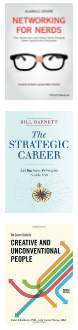
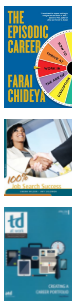
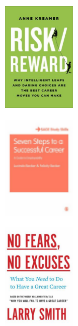
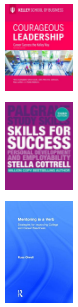
Career Book Collection - This featured group of books is part of a special
collection ACC Library Services added in 2016. It includes books on networking,
leadership, college and career success, plus so much more!


Career1.png    Career3.png   Career2.png     Career4.png   Career5.png

There's a multitude of information and resources available to you about careers
and employment. Let ACC Library Services help you find it!

Friday, November 30, 2018

The Era of Spin: Fake News, False Headlines and Deliberate Misinformation

24/7 Feed Updates


In today’s modern era, we are constantly bombarded with news and information. With nonstop updates and instant access, it is possible to consume media around-the-clock. The Pew Research Center recently found that people under 50 years-old, consume half of their news online. And for for those under 30, online news is twice as popular as TV news (Nagler 1).


We scroll our social media stream, browse the Internet, watch television, listen to the radio, read the newspaper and talk with friends and family. Whatever the source, the news stream is a steady torrent.


While some of this information is well-researched, fair and factual, there are numerous news stories that are blatantly false.
Enter: Fake News.
In the past couple of years, fake news has become a widespread buzzword in the American lexicon. But what exactly is fake news?


#PizzaGate, Pope Francis Endorses Donald Trump


Fake news is fabricated information that mimics news media content in form, but not in process or intent. Fake news outlets lack editorial norms and processes that ensure accuracy and credibility of information ("Fake News, Alternative Facts and Misinformation"). Said simply, fake news is information that is untrue and cannot be verified.


At first blush, these stories can seem accurate, but actually contain fictitious and sometimes deliberately sinister information.

With the proliferation of clickbait headlines, people sometimes re-share content in their social media feeds before they evaluate it, verify it or even read it. This creates a viral typhoon of misinformation and distorted facts, which can lead to serious real-world consequences.

Before you share. First verify. Pause and reflect.


Don’t Be Duped. Consume Wisely.


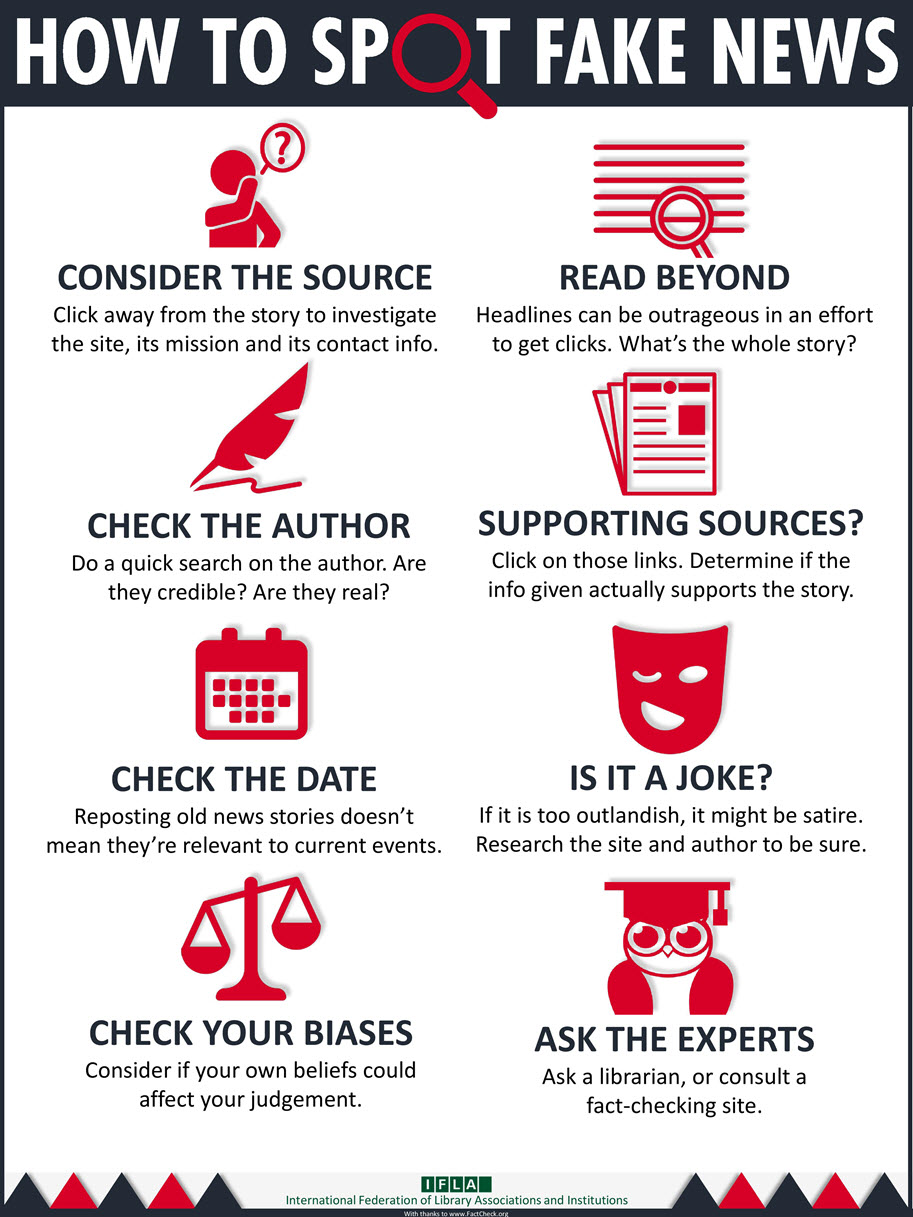
It is more important than ever to critically evaluate news (and all information) for its reliability and truth. Be skeptical of the information that you come into contact with. Question. Have doubts. Independently verify a source. And form your own opinions.


Ask yourself: Who wrote this and why? Search the author’s name. Is this person an expert on the topic? Is the information trustworthy and factual? Can you find this same news in multiple places?


Analyze a source from multiple perspectives. What explicit and implicit biases exist in the article? What is the author’s intent? Do they cite their sources?


Also, be aware of your own partialities and blind spots. Simply put, people are more likely to accept information that confirms their beliefs and dismiss information that does not. This behavior is known as confirmation bias.


But perhaps most importantly, read widely and read often. Read from multiple sources and read multiple points of view. Read from sources that differ from your own opinions.


Don’t just blindly accept the first results that pop onto your screen. Or mindlessly accept what you are told. Be persistent in your reserach and sift deeper.


Informed Citizenry is a Cornerstone of Democracy


"Congress shall make no law respecting an establishment of religion, or prohibiting the free exercise thereof; or abridging the freedom of speech, or of the press; or the right of the people peaceably to assemble, and to petition the Government for a redress of grievances" ("America's Founding Documents--The Bill of Rights: A Transcription").
It is a civic duty to act as an informed citizen and as a protector of rational scholarship. In the 21st Century, media literacy is an essential life skill that enables you to do so.
Be wary of: the suppression of contradictory views, appeals to prejudices, personal attacks, excessive claims of certainty and emotional appeals.
It is imperative to protect objective realities, accurate facts and balanced viewpoints.


ACC Libraries and Fake News


ACC has a vast collection of reliable and credible resources available to students, staff and faculty (A-Z List of All Databases, eBooks, books, Information Literacy sessions and more). Stop by an ACC library today and speak with a faculty librarian or use our 24/7 chat feature.


Also, to find out more about Fake News, visit our Fake News Research Guide.


Works Cited


"America's Founding Documents--The Bill of Rights: A Transcription." National Archives, https://www.archives.gov/founding-docs/bill-of-rights-transcript. 

"Fake News, Alternative Facts and Misinformation: Learning to Critically Evaluate Media Sources." Cornell University Library, 2018, https://guides.library.cornell.edu/evaluate_news.

Nagler, Christina."4 Tips for Spotting a Fake News Story." Harvard Summer School, 2018, https://www.summer.harvard.edu/inside-summer/4-tips-spotting-fake-news-story.


Monday, November 26, 2018

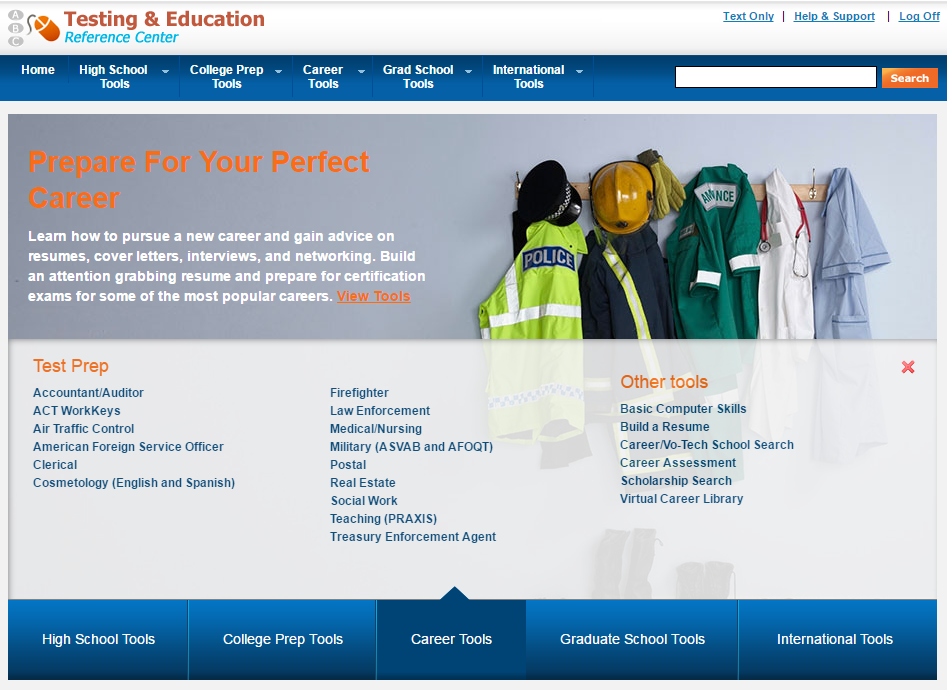
Ferguson's Career Guidance Center


Explore Industries and Careers

Choosing a career is a challenging decision. Many different professions can suit your skills, interests, and goals. Here you can learn about more than 140 different industries and careers fields and thousands of professions to find the right one for you.


Popular Industries
  • Advertising and Marketing
  • Computer Software
  • Government
  • Pharmaceuticals and Biotechnology
  • Travel and Leisure
Popular Careers
  • Biomedical Engineers
  • Elementary School Teachers
  • Home Health Care Aides
  • Lawyers and Judges
  • Registered Nurses

Plan Your Education

Planning for college or another educational path can be a complex process. Advice and resources in this section will help you get organized, find your best options, identify your goals, and locate the schools that fit you best.

  • College Planning Timeline
  • Choosing a College
  • Choosing a College Major
  • Applying for Student Loans
  • Work-Study Programs
  • Financial Aid Directories
And more...

Launch Your Career

Hard work and job skills alone don't guarantee career success. Employers also look for professional appearance, good organization, time management, and many other basic skills of the modern workplace, which you can practice and perfect with the advice here.

Career Skills
  • Why You Need a Resume
  • Achieving Professional Excellence
  • Cover Letters: Common Mistakes
  • Researching Career Options
  • Preparing for the Interview
Apprenticeships and Internships
  • History of Apprenticeships
  • Applying and Interviewing for an Apprenticeship
  • Locating an Internship
  • Internships and Lifelong Job Skills
  • Government Internships
Career Interest Assessment

Discover the occupations and industries that best match your personal interests.

Monday, November 12, 2018

November is National Novel Writing Month!

Photograph of open book with title floating above.


Working on your writing skills? ACC Libraries have resources available to assist you, whether you are completing an essay or have larger publishing aspirations.


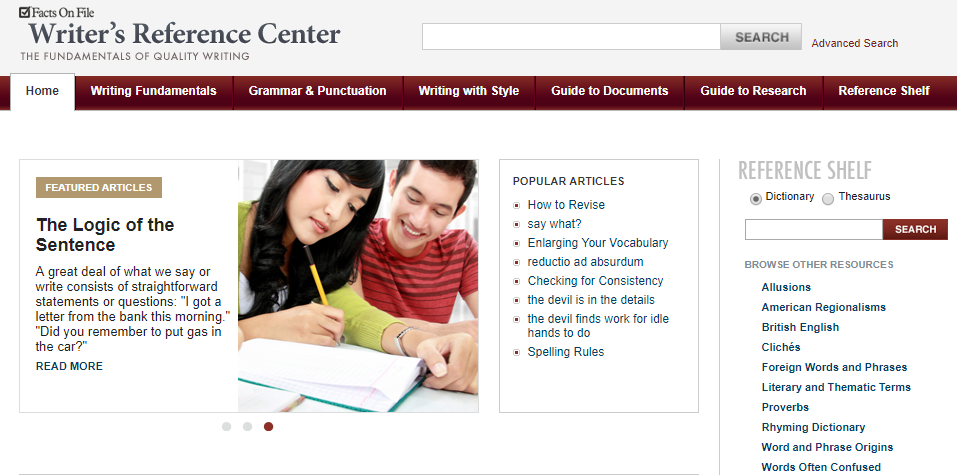
Facts on File Writer’s Reference Center is a database devoted to writing.


Grammar and punctuation, research basics, choosing a topic, types of documents, adding style to your writing, and other fundamentals of writing are at your fingertips.


Locate this database and more on the library’s website under A-Z List of Databases.

Additional resources available from your ACC Libraries:
book cover for Ticket to Write: Writing College Essays by Susan Thurman
Available from your ACC Library:
Ticket to Write: Writing College Essays by Susan Thurman
Book cover for Fast Fiction by Denise Jaden
Available from your ACC Library:
Fast Fiction: A guide to outlining and writing a first-draft novel in 30 days
by Denise Jaden 
   
book cover for No Plot? No Problem! by Chris Baty
Available from your ACC Library:
No Plot? No Problem! A Low-Stress, High-Velocity Guide to Writing  Novel in 30 Days
by Chris Baty


Ready to write a novel? NaNoWriMo, a nonprofit organization, is a fun way to challenge yourself while collaborating with other aspiring novelists! 
With a goal of writing a 50,000 word novel in the month of November, writers can earn badges, engage in pep talks with published authors, and scour inspirational resources along the way. NaNoWriMo sponsors interactive forums for members to discuss plot holes, character naming, facts, and other details needed for the perfect page-turner.

Sunday, October 28, 2018

The Case of the Mysterious Painting: A JSTOR Detective Story


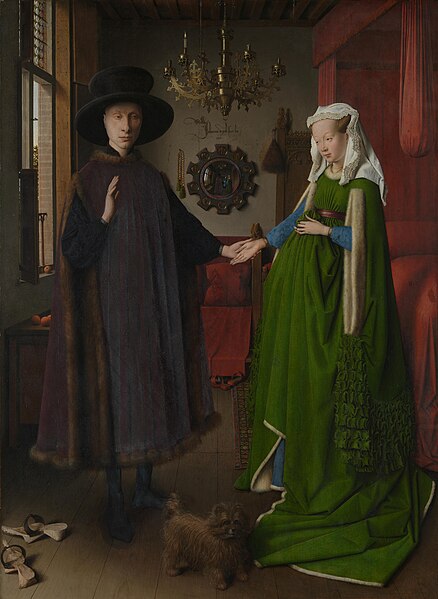
File:Van Eyck - Arnolfini Portrait.jpg
Portrait by Jan Van Eyck, 1434  (Wikimedia Commons)
This painting by the Dutch master Jan Van Eyck, much admired for its beauty and display of artistic skill, is at the same time mysterious and intriguing. At first glance it looks like a serious, solemn occasion. But look! There's a dog at the couple's feet, and the man is standing without any shoes on! And why is there only one candle in the chandelier, and why is that one candle lit when, in fact, plenty of daylight is coming in through the window?

In a famous article published in 1934, and now in JSTOR, an online repository of scholarly research, Erwin Panofsky drew upon the medieval symbolism of these and other "clues" in the painting to argue that this was a wedding ceremony between Giovanni Arnolfini and his wife, Jeanne de Cenami (117, 126).

Panofsky asserted, for example, that the single candle burning in the chandelier represented a "marriage candle" used in various ways at the time when a couple was getting married. He pointed to the dog as indicating faithfulness between a husband and wife. And Panofsky claimed that Giovanni's sandals alluded to "terra sancta," sacred ground, further supporting his wedding thesis (126).

For decades art historians admired "Panofsky's classic text" as "interpretive truth" and "reconstructed fact" (Seidel, 57). Indeed, the painting has often been titled The Arnolfini Wedding. But especially recently, some art historians are reaching different conclusions about this masterpiece. In another article that can be found in the JSTOR database, for example, Herman Colenbrander contends that Van Eyck was actually depicting a “Morgensprache,” in which the husband gave gifts to his bride the morning after their marriage (422).

How about this theory: The painting is a record of a secret loan, the bride's dowry, no less, sneakily made to skirt around the usury laws of the time! In yet another article in JSTOR, Linda Seidel proffers the painting as proof that the bride's family could use to reclaim such a loan (71-72). Seidel alleges, for example, that Jan Van Eyck served as a "notary," as evidenced by the mirror in the painting's background, which she sees as symbolizing the "seal" of a notary on a document (69-70). As a cloth merchant, Giovanni Arnolfini could use this loan to fund his business (72).

Why should we care how this portrait is interpreted? Because it gives us an example of an
immensely important undertaking for all of us--discerning truth. Throughout our lives we need to continuously examine and question both the truth claims of others and ourselves. The JSTOR database contains countless works by scholars who are in dialog with one another to uncover the best ways to interpret aspects of our world, be they causes of social ailments, themes in literary works, or, as we have seen, the meanings of visual art works.

This semester your more immediate concern may be finding scholarly sources for your paper or project, and JSTOR is a great place to look! JSTOR indexes thousands of scholarly publications, especially in the humanities, social sciences, and life sciences. JSTOR also provides millions of pages of full-text, including primary source documents and books as well as journal articles, some written well over a century ago.*


Searching JSTOR:

From the library home page at library.austincc.edu, click on A-Z List of Databases.

1.  At the alphabetical sequence near the top of the page, click on the J.
2.  Click on the JSTOR link. (If off campus, you will then need to log in.)
3.  Below the search box that appears, click on the Advanced Search link.

4.  Enter search terms in the search boxes that appear.
5.  From the drop down menu to the right of each search box, select the field in which each search term will be searched.
6.  To add search boxes, click on the Add a search box button below the last search box.
7.  Narrow by item types, such as articles, by clicking on the appropriate check boxes.
8.  Narrowing the search further by date, language, etc. is usually unnecessary.  When you are ready to execute your search, click on the Search button.

For more information on searching JSTOR, please feel free to consult with an ACC librarian. JSTOR also offers excellent guidance. JSTOR's tutorials include basic and advanced searching techniques, sorting and reviewing search results, and using JSTOR on a mobile device. Have fun exploring the wealth of scholarly resources JSTOR offers!


Works Cited

Colenbrander, Herman Th. “‘In Promises Anyone Can Be Rich!" Jan Van Eyck's Arnolfini

     Double Portrait: A ‘Morgengave.’” Zeitschrift Für Kunstgeschichte, vol. 68, no. 3,

     2005, pp. 413–424. JSTOR, JSTOR, www.jstor.org/stable/20474305.

Panofsky, Erwin. “Jan Van Eyck's Arnolfini Portrait.” The Burlington Magazine for

     Connoisseurs, vol. 64, no. 372, 1934, pp. 117–127. JSTOR, JSTOR,

     www.jstor.org/stable/865802.

Seidel, Linda. “‘Jan Van Eyck's Arnolfini Portrait’: Business as Usual?” Critical Inquiry,

     vol. 16, no. 1, 1989, pp. 55–86. JSTOR, JSTOR, www.jstor.org/stable/1343626.


Note:
* Full-text coverage in JSTOR varies from publication to publication.  For most periodicals, an embargo on the most recent five years of articles is in effect. That is, JSTOR often indexes a periodical up to the present without providing full-text to the periodical’s most recent five years of articles. For more recent articles, you may wish to search some of the other great databases that ACC's libraries provide.

Sunday, October 14, 2018

National Veterinary Technician Week, October 14-20


The National Association of Veterinary Technicians in America has declared October 14-20th National Veterinary Technician Week! So show some love to our amazing Veterinary Technician students and the Vet Tech Faculty and Staff!

View this image and more at ACC's Flickr Photostream.

What is a Veterinary Technician? This occupation, that is projected to grow by 20% in the next ten years, consists of performing medical tests and assisting in the diagnosing of injuries and illnesses in animals. Learn more about the local economy from the ACC Health Sciences webpage.
Successful graduates have gone on to work in veterinary clinics, hospitals, research facilities, and private practices.

Interested in pursuing an Associate of Applied Science in Veterinary Technology degree? Check out the degree plan to see how you can get started and what lies ahead. Learn more about ACC's Vet Tech program on their homepage.

Vet Tech library materials are housed at the Elgin campus. Check out the latest titles and more on our Vet Tech Research Guide. While you're at it, relieve some stress along the way through a Guided Meditation.

Monday, October 1, 2018

Voter Registration & Election Info

Voter Registration & Election Info

Election 2018

On November 6th, Americans will have the opportunity to exercise the most important responsibility we have in a democracy – our right to vote. Please take some time to review the resources and information listed below. And get out there and VOTE!

Registering to Vote:

You must register before you can vote. The last day to register to vote for the 2018 Congressional Election is October 9th. You can register in person or by mail. VoteTexas.gov has information on registering to vote in your county. You can check to see if you are already registered on the Am I Registered? Website.

Early Voting:

Early voting in Texas will be held from October 22nd to November 2nd. All registered Texas voters can vote early in person. Bring an acceptable form of photo ID. You can find your early voting locations using the Am I Registered? Website.

Election Day:

Polls are open from 7am to 7pm on November 6th, Election Day. Bring an acceptable form of photo ID. You can find your poll location using the Am I Registered? Website.

What's on the Ballot?:

You can find out what will be on the ballot at VoteTexas.gov. The League of Women's Voters also publishes a non-partisan voters' guide for the counties around Austin.

More Information:

For more information on elections and voting, check out the library's Government Subject Guide. The library also has books on U.S. Congressional Elections, Political Campaigns, and Political Culture.